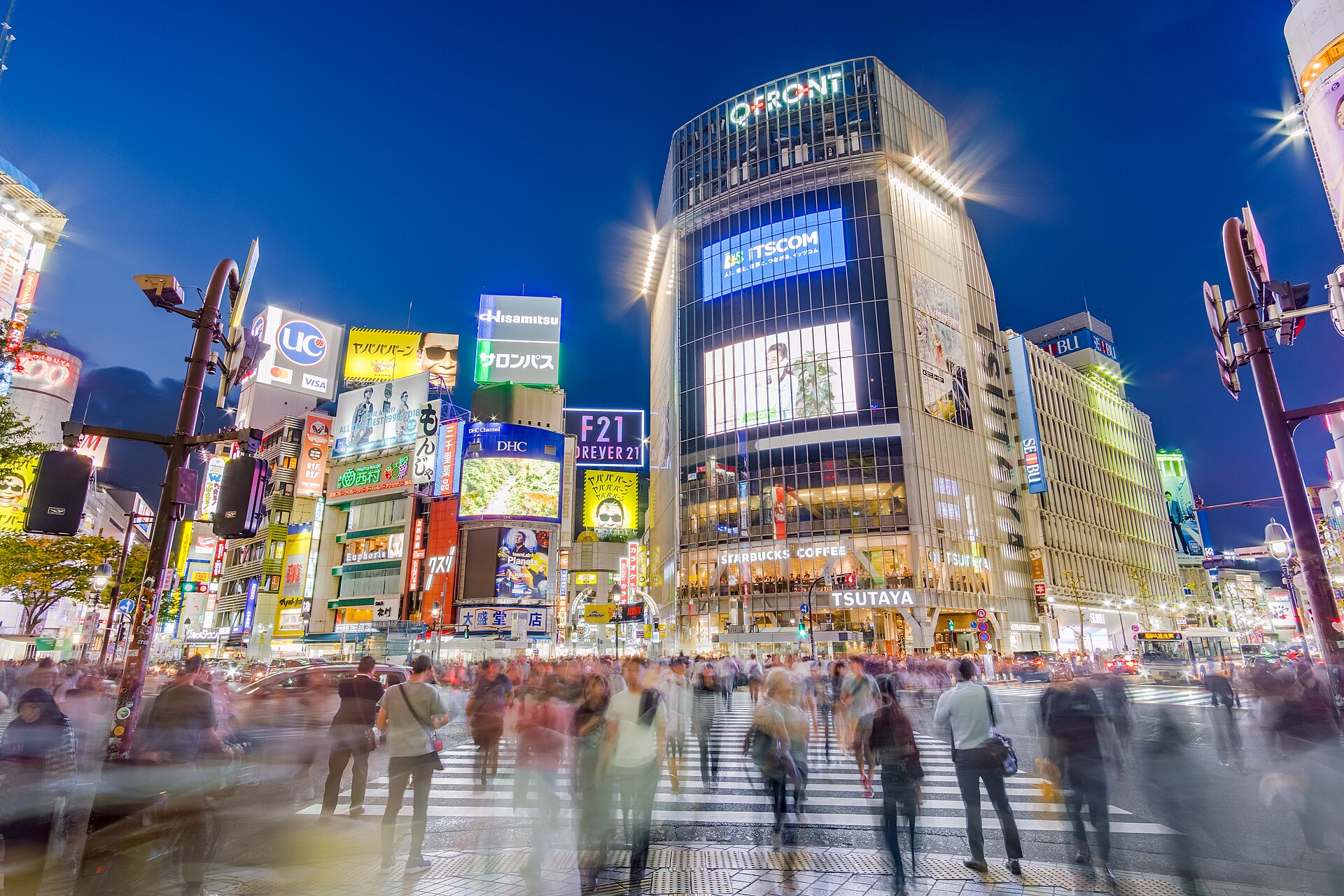
 First Day
Tokyo, Japan
Shibuya to Harajuku First Steps
A short, high-contrast walk from the world's busiest crossing to a quiet forest shrine, then out into Harajuku's fashion streets.
- Duration
- 3 hr
- Distance
- 3.8 km
- Difficulty
- Easy

Japan, Asia
An enormous, meticulously organised city where walking between train stations reveals far more than the trains themselves.
Photo: Front view of an illuminated outdoor escalator, Shinjuku Station, Tokyo
Why walk here
Tokyo is vast, so no visitor walks the whole city, but individual districts like Shibuya, Shinjuku, Asakusa and Yanaka are each highly walkable, with clean, well-maintained pavements and a level of pedestrian infrastructure that makes wandering comfortable even for hours at a stretch.
The city's layout is not a simple grid, having grown organically around old roads and waterways, so street names are used far less than landmarks and block numbers, and getting slightly lost in a quiet residential backstreet is a normal, often charming part of exploring on foot.
Crowds around major stations like Shinjuku or Shibuya can be intense at peak times, and walking through them takes a bit of a different rhythm than the calmer backstreets elsewhere, so timing a route to avoid rush hour where possible makes for a smoother day.

Practical notes
Written for someone who has just landed and does not want to read a guidebook.
Tokyo's train and subway network is famously extensive and reliable, run by multiple companies but unified for payment through the Suica or Pasmo IC cards, which also work on buses and in many shops. Trains are the fastest way to cover the city's scale, with walking best reserved for exploring within a station's surrounding neighbourhood. The Narita Express and Skyliner trains, or the Keikyu line from Haneda, connect the airports to central Tokyo efficiently.
Tokyo is remarkably safe to walk through at nearly any hour, including late at night in central entertainment districts, with violent crime very rare and even petty theft uncommon by international standards. Normal awareness in crowded areas like festivals or packed trains is still sensible, but Tokyo consistently ranks among the safest large cities for pedestrians.
Tipping is not customary in Japan and can occasionally cause confusion if offered, since good service is considered the standard rather than something to be additionally rewarded. Leaving money on a table is generally not expected and may even be quietly returned.
Tap water is safe and commonly drunk straight from the tap throughout the city. Many shops keep long hours, with convenience stores open around the clock, though some independent shops close one day a week. Cash is still used more than in many other advanced economies, though card and contactless payment has expanded considerably in recent years. Japanese is the local language, and while English signage exists in major stations, basic phrases help in smaller neighbourhoods. Summers are hot and humid, while spring, especially cherry blossom season, and autumn are the most pleasant for walking.
Walks in this city
Pick one, screenshot the cards, and leave the phone in your pocket between stops.
First DayTokyo, Japan
A short, high-contrast walk from the world's busiest crossing to a quiet forest shrine, then out into Harajuku's fashion streets.
 Special
Tokyo, Japan
A dusk-to-dark walk through an old wooden neighbourhood and into neon-lit Ueno, timed so the light changes as you go.